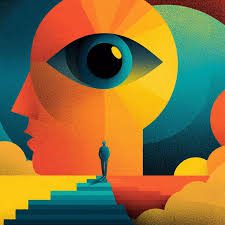

Human beings often trust their experiences as the ultimate source of truth. If we see something, feel something, or go through something personally, we tend to assume it must be real and absolute. But when we observe the nature of the mind carefully, a deeper insight appears: whatever can be experienced cannot be absolute.
This idea challenges our common assumptions about truth, perception, and reality. Our experiences are not pure reflections of the world; they are interpretations shaped by the mind, memories, and conditioning. To understand this better, let us explore how the mind works and why experience cannot represent absolute truth.
Experiences Are Filtered Through the Mind
Whatever we experience is experienced by the mind itself with the help of the sense organs. Our senses collect information, and the mind interprets it.
However, the same event can create different perspectives, feelings, or reactions in different people, because each person has a different mind.
But what exactly is the mind?
The mind is essentially a set of memories, neural pathways, and chemical compositions, along with the reactions of chemicals secreted within the body. Because of this, the present perspective of an event is determined by the present structure of the mind.
And this structure is not fixed. The present structure of the mind is based on past experiences, memories, and beliefs.
This leads to an important realization:
The experiences we have are not fresh. They are shaped by the past.
In other words, we never observe reality directly. We observe reality through the lens of our past.
The Past Also Changes With the Present
Not only does the past influence the present, but the present also reshapes the past.
Example: A Party Incident
Suppose you attended a party two years ago. During that party, someone humiliated you. You returned home feeling hurt and angry, holding a grudge against that person and the entire environment.
Your mind began creating interpretations:
- You assumed that the person disliked you.
- You started reviewing all their past behavior negatively.
- Every interaction seemed hostile or disrespectful.
Your mind built a complete narrative around the event.
But imagine that later you discover something unexpected.
You learn that the person intentionally humiliated you so that you would leave the party early. That person was actually your well-wisher. There was a possibility that someone at the party planned to attack you, and the humiliation was a way to protect you by forcing you to leave.
Now everything changes.
Suddenly:
- Your perspective of that person changes completely.
- Your earlier interpretations collapse.
- Behaviors that once seemed hostile now appear protective.
- Even the minute details of the party—the lighting, music, and atmosphere—start appearing different in your memory.
This shows something fascinating:
Your past has changed because your present understanding changed.
Past and Present Are Interconnected
From this example, we can see that:
- The present is shaped by past conditioning.
- The past is reshaped by present understanding.
Neither past nor present is absolute. Both are interconnected and constantly evolving as the structure of the mind changes.
If you read good books or meet insightful people, your thought process begins to change. As your thinking evolves, the structure of the mind also changes.
And when the mind changes, your perception of events also changes.
The same phenomenon begins to appear in different colors.
Because of this, something that once appeared true may later appear false, and something that seemed false may appear true. For the mind, truth and falsehood exist within a range determined by its structure.
The Same Event Creates Different Experiences
Since each person has a different mental structure, the same event produces different experiences for different people.
But it goes even deeper.
Even the same person can experience the same event differently at different times, because the structure of the mind changes over time.
Therefore:
- Different people → different experiences of the same event
- Same person at different times → different experiences of the same event
This means experience itself is unstable.
The Mind Is Like a Camera
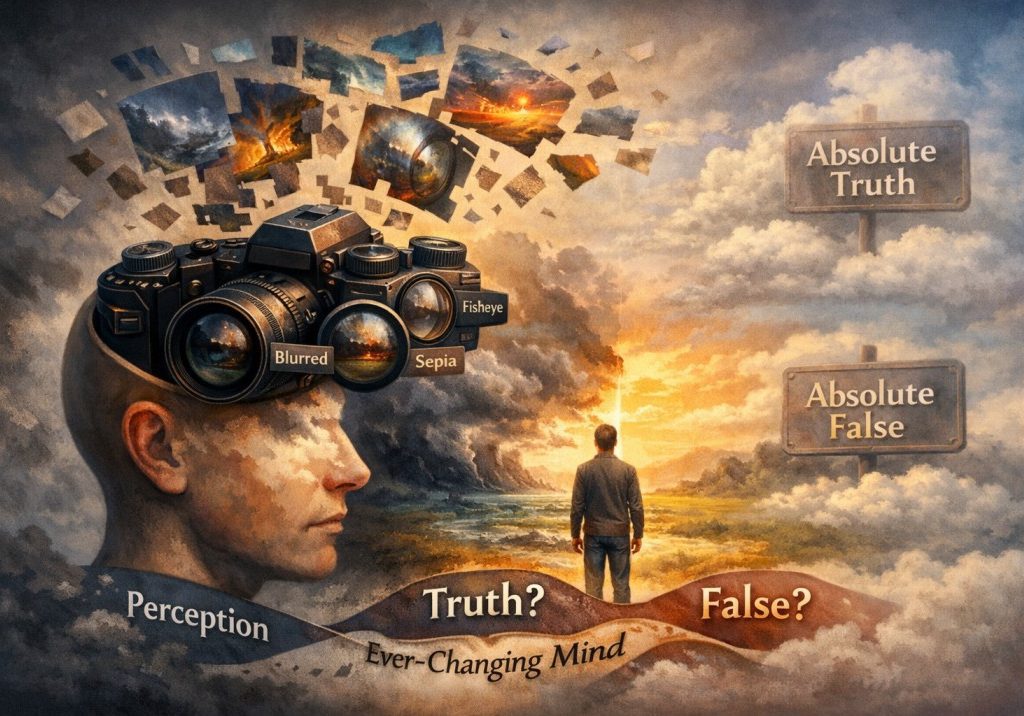
The mind can be compared to a camera.
When the functions or settings of a camera change, the quality and nature of the image also change. Similarly, when the functioning of the mind changes, the perception of events also changes.
Because of this, it is inaccurate to talk about a fixed mind. It is more accurate to think of it as a scattered and ever-changing mind.
Since the mind constantly changes, experience cannot be relied upon as a final authority to determine truth or falsehood.
Truth and falseness exist only within a range created by the mind, which itself is always changing.
Therefore:
Absolute truth or absolute falsehood cannot exist within experience, because experience always occurs through the mind.
The Mind as a Pattern Finder
Another important characteristic of the mind is that it constantly searches for patterns.
The universe appears chaotic and unpredictable. To survive in such a world, the mind tries to detect patterns so that it can predict the future and increase the probability of survival.
When the mind finds patterns, it feels supported and secure. These patterns help it validate its own existence.
Otherwise, the mind may collapse into confusion if it realizes that the body and existence may have simply appeared without any clear cause.
Even the statement “it just appears” is itself a mental pattern.
Without patterns, the mind feels helpless.
That is why the human mind has developed numerous systems and frameworks, such as:
- Laws of physics
- Chemistry
- Biology
- Philosophy
- Psychology
- Theology
Even the concept of God can be seen as a pattern created by the mind to provide validation, meaning, and psychological stability.
Without such structures, the mind might fall into nihilism, where life appears meaningless.
The Conceptual World of the Mind
Because of this pattern-seeking nature, the mind lives within a conceptual world full of ideas, beliefs, and interpretations.
However, this conceptual world can also become a trap.
The mind creates concepts to understand reality, but then it becomes entangled within its own creations, which leads to confusion and suffering.
The entire structure of the mind itself is made of concepts. If something is conceptual and constantly evolving, it cannot be absolute.
Concepts Are Collective, Not Individual
The concepts that shape our minds are not created by individuals alone.
They are built over millions of years of human civilization.
In a way, the human mind carries the memory of the entire civilization.
Societies function based on large, shared concepts—culture, morality, religion, social norms, and philosophies.
Each individual has their own personal philosophy, but its foundation often comes from these collective concepts. What differs between individuals is mostly the surface structure.
Because philosophy evolves over time, human experience also evolves.
For example, societal norms in 2000 B.C. were very different from those of today. Naturally, people’s experiences, interpretations, and emotions were also different.
So how can something that constantly changes produce something absolute?
It cannot.
The Mind Projects the World
Another profound observation is that the world we experience—whether in waking or dreaming—appears through the activity of the mind.
Just as the mind projects thoughts, it also projects the world of experience.
When the mind becomes active, the world appears in front of us.
But the mind itself is not fully under our control. It functions like a self-processing unit.
Example: The Railway Station
Imagine standing in a crowded railway station.
There are people everywhere. You can hear whistles, announcements, and movement all around.
But suppose you suddenly become deeply lost in thought—perhaps thinking about someone you love.
In that moment:
- The crowd seems to disappear.
- The announcements fade away.
- The surrounding environment becomes almost invisible.
Why?
Because the mind is no longer processing the railway station. Instead, it is absorbed in a different thought.
This shows that the world we experience depends on what the mind processes.
If the Mind Is Not Absolute, Experience Cannot Be Absolute
Since the mind is the lens through which we experience the world, and since the mind itself is unstable and constantly changing, the world as experienced cannot be absolute.
If the lens is not absolute, the image cannot be absolute.
Therefore:
- The world we perceive
- The truth we believe
- The falsehood we reject
—all exist within the limitations of the mind.
Then What Is Truth or Absolute?
This naturally leads to a deeper question:
If experience cannot reveal absolute truth, then what is truth?
The answer may lie beyond the mind.
But here another challenge appears.
Everything we can think about—every idea, concept, or imagination—belongs to the realm of the mind.
Even the word “nothing” is itself a concept created by the mind.
So how can truth be known if it lies beyond the mind?
The Fundamental Question
To approach truth, the mind must ask a radical question:
“Who is seeking the truth?”
The answer appears simple:
The mind itself is seeking the truth.
When the mind realizes this, it begins to see its own limitations. It may gain insights about truth, but it cannot fully experience the absolute.
Why?
Because the mind is ever-changing, volatile, and conceptual, while truth—if absolute—cannot be dependent on something unstable.
Final Thought
Experience is valuable, but it is not the ultimate authority. Every experience is filtered through mind that is memories, beliefs, biology, and culture.
The mind interprets reality rather than directly reflecting it.
Therefore:
Whatever can be experienced through the mind cannot be absolute.
To explore this idea further and dive deeper into the nature of self and consciousness, read the related article:
“Who Am I? I’m The Ghost.” https://mindalysis.com/im-the-ghost/