
Introduction: From Foraging to Farming
For 2.5 million years, humans fed themselves by hunting and gathering. All changed about 10,000 years ago when the Agricultural Revolution occurred, and side by side artificial selection began to take place. This shift from foraging to farming transformed human society forever.
The Agricultural Revolution was the shift from hunting and gathering to farming and settled life about 10,000 years ago. Humans began cultivating crops and domesticating animals, leading to surplus food, population growth, and the rise of civilizations. It transformed human society, work patterns, and social structures. And it seems that humans selected crops and animals, but if you see deeply then you can see that actually they selected human beings to take care of them in the name of the Agricultural Revolution.
Artificial Selection vs Natural Selection
Natural selection and artificial selection both influence the traits of organisms, but they operate through different mechanisms.
- Natural selection is an unguided process in which environmental pressures favor traits that improve survival and reproduction. For example, giraffes with longer necks were more likely to access food and pass on their genes, and polar animals evolved thick fur to survive cold climates.
- Artificial selection, by contrast, is driven by human choice, where humans intentionally breed organisms for desired traits. Examples include the development of diverse dog breeds from wolves, cows bred for higher milk production, and wild mustard selectively bred into cabbage, broccoli, and cauliflower.
While natural selection produces adaptations suited for survival in nature, artificial selection promotes traits beneficial or appealing to humans.
Did Humans Domesticate Wheat — Or Did Wheat Domesticate Humans?
It appears that humans selected wheat. But if you look deeply, you may see that wheat selected humans to serve it.
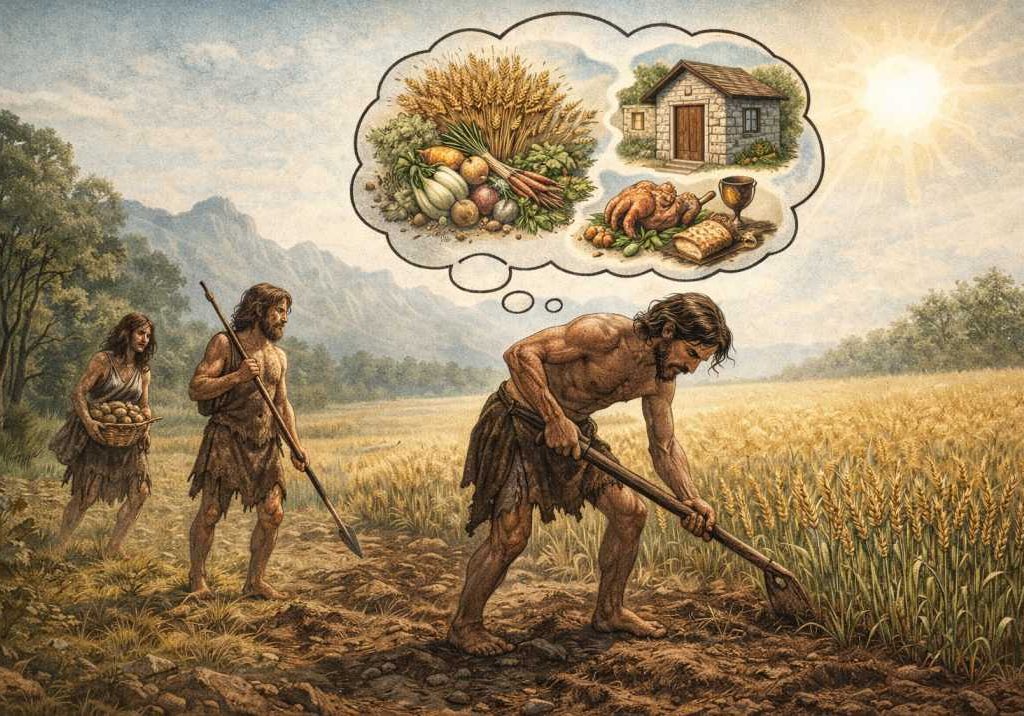
Wheat manipulated human beings to its advantage. To grow wheat, sapiens cleared rocks and pebbles, broke their backs working hard, provided water, fertilizers, and cut canals. Men and women labored long days weeding under the scorching sun. When wheat got sick, humans had to protect it from worms and blights.
Humans did not evolve for this. They evolved to climb trees for fruits and run after deer. Yet they ended up carrying water buckets and serving agricultural species. In exchange, they received the imagination of future happiness and security, often at the expense of present playfulness and freedom.
Benefits of the Agricultural Revolution
1. Surplus Food and Civilization
Benefit:
It provides surplus food. This extra diet led to future security and population explosion. It allowed humans to invest extra time in science, economy, polity, and other fields. Civilization, cities, and complex societies became possible.
Disadvantages of the Agricultural Revolution
1. Psychological Slavery
People became slaves of future necessities such as food and safety. They began gathering wealth. Life lost its grounding in present satisfaction and took root in imaginary future desires. The future never gets fulfilled because dissatisfaction becomes a habit. The present remains unsatisfied while focus shifts constantly toward an imagined desirable future.
It is not that we should not work. We should work immensely, but not for future luxury. Work according to one’s tendency for present happiness. This brings both present joy and a better future without excessive desire that leads to grief.
Ancient foragers had more leisure time. They lived with insecurity but did not obsess over securing the future. Today, we devote our lives to securing tomorrow at the expense of present happiness. That has made life miserable.
2. Less Variety and Ecological Damage & Moral Question
Although agriculture provided surplus food, it reduced dietary diversity compared to the varied diet of foragers. Cereal-based diets often have lower nutritional value.
Today humans have higher cognitive ability and sensitivity. They can feel the pain of other species. In ancient times, many species were destroyed for survival. But now the question is about consciousness and responsibility.
If destruction continues due to uncontrolled consumption, the system itself may collapse. Climate change, disruption of food chains, and extinction of vital organisms threaten human survival.
3. Dependence, Conflict, and Social Hierarchy
As humans became dependent on agriculture, they became dependent on land, rain, and climate. Droughts, floods, or locust attacks could destroy entire food supplies and cause starvation.
Since people had abandoned hunting and gathering, alternative food sources were limited. This led to conflict between groups. Humans attacked each other and stole crops. Enmity grew.
To manage conflict, political systems emerged. Hierarchies formed. Lower classes worked harder and received less. Higher classes exploited them. Kingdoms appeared. The ruler and the ruled divided society. This misery gave rise to political and philosophical thought.
Although the Agricultural Revolution increased the number of human DNA copies — evolutionary success — it brought psychological suffering and poor quality of life. And we remain in this race even today.
The Population Cycle of Misery
When farming began, food became abundant. Abundance led to more births and population explosion. Cereal-based diets reduced nutritional diversity. Lower nutrition and less breastfeeding increased mortality, but birth rates remained high.
More population created demand for more food and security. That required more hard work. More hard work supported more population. The cycle continued.
Farming → Food Abundance → Population Growth → More Demand → More Hard Work → Supports Larger Population → Farming Expands → Repeat
In this endless pursuit of “more,” people lived insecure and miserable lives. This not only harmed humans but also the entire planet. It led to climate change and cruelty toward other species in the name of domestication.
Domesticated Animals: Evolutionary Success, Existential Misery
As wheat domesticated us in search of future pleasure and security, in the same way we domesticated and artificially selected animals such as pigs, cattle, and hens. They too achieved evolutionary success, as they are now among the most numerous animals in the world after human beings. But although they outnumber many other species in billions, their lives have become miserable because of humans.
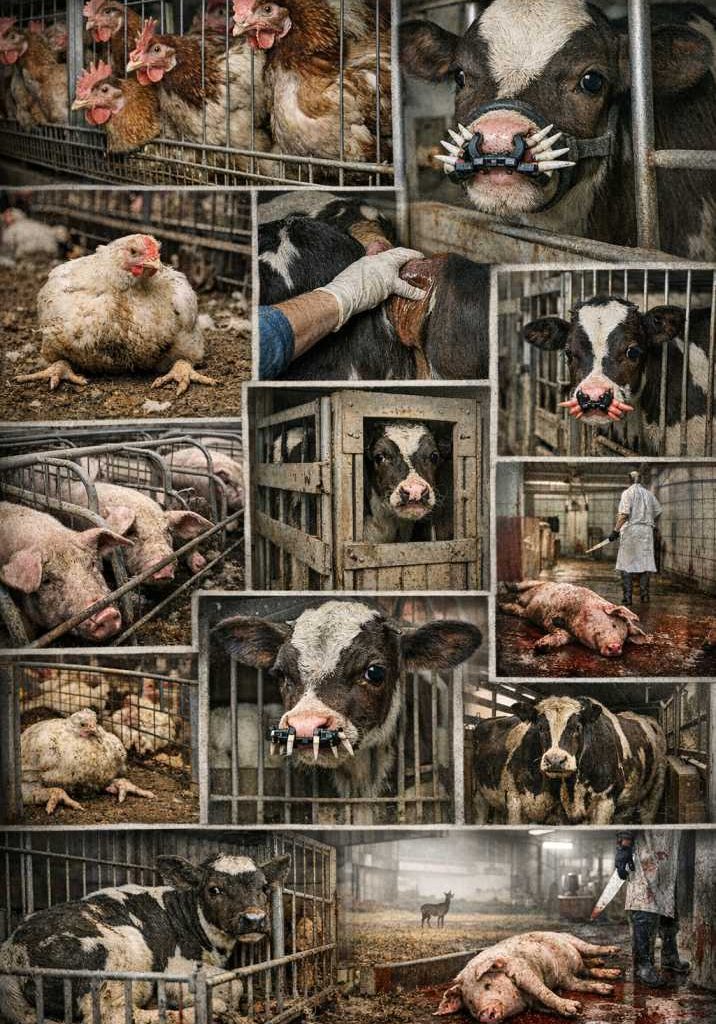
The production of chicken and cattle for meat, milk, and eggs subjects them to deep suffering. They are forced to live in overcrowded farms and end their lives in slaughterhouses. Many hens are confined in tiny cages where they cannot spread their wings. Chickens bred for meat grow unnaturally fast, often unable to support their own weight. Cattle are repeatedly artificially inseminated so they continue producing milk. Calves are separated from their mothers soon after birth. To stop them from suckling, devices with thorns or spikes are sometimes placed on their mouths. Many animals spend their entire lives imprisoned in narrow enclosures without natural movement, sunlight, or freedom.
Thus, though they have evolutionary success in numbers, their lives are filled with suffering. In that sense, their success becomes meaningless. A rare species on the brink of extinction may be more satisfied in freedom than a calf that spends its short life inside a tiny box, fattened only to produce meat, milk, or eggs.
Conclusion: Is This Progress or a Story of Misery?
In this way, human beings have become a bane for the Earth. In the search for pleasure and security, humans have made not only their own lives restless but also the lives of other species miserable. The cruelty inflicted on domesticated animals is severe and inhumane.
Perhaps humanity pays the price of this cruelty through climate change, psychological stress, painful diseases, wars, artificial calamities, and natural disasters intensified by human actions.
The Agricultural Revolution gave humans evolutionary success in numbers. But it also created cycles of dependency, suffering, insecurity, and ecological destruction. The real question remains: Is numerical success true progress, or is it the long story of development of misery?