
Introduction: A Question Older Than Humanity
Is there truly something called alive or dead? Or are these merely labels created by the human brain to describe ongoing natural processes? This article explores the idea that everything in the universe—humans included—is part of a continuous, self-running animation governed by natural laws. Within this unfolding movement, a deeper question arises: where is the sense of “I”?
This exploration is philosophical, scientific, and reflective in nature, written to encourage awareness rather than belief.
1. Matter, Energy, and Natural Formation
The universe is composed of matter and energy, and matter itself is a manifestation of energy. Modern physics confirms this relationship through Einstein’s mass–energy equivalence (E = mc²), showing that matter and energy are interchangeable forms of the same reality.
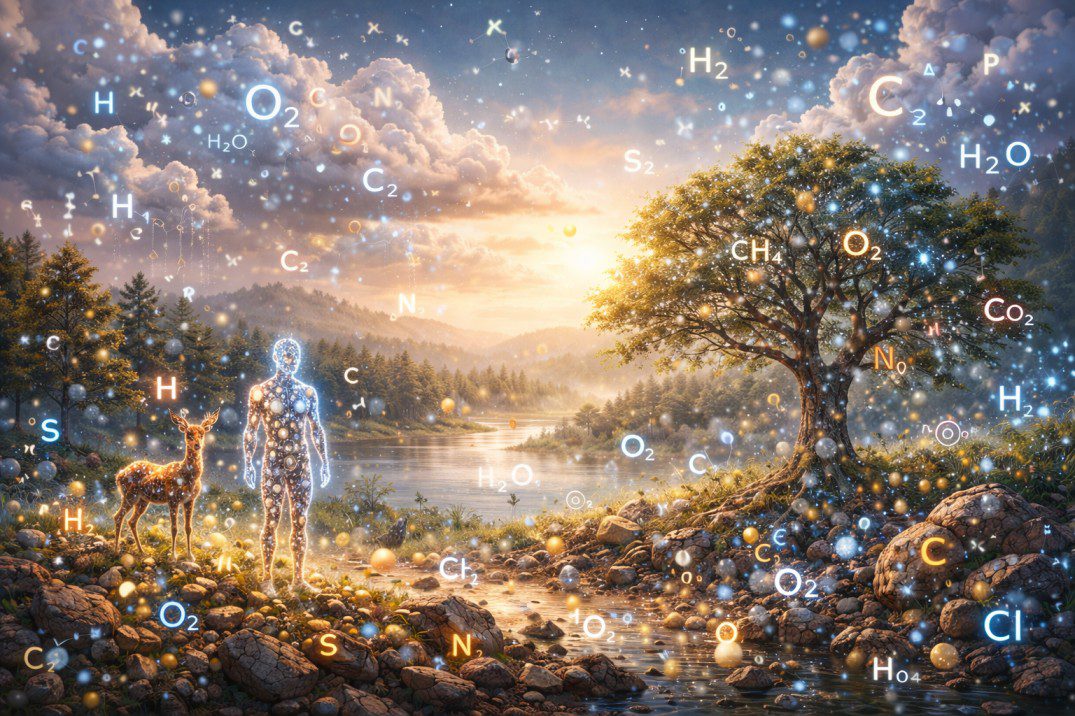
On Earth, elements such as hydrogen, oxygen, carbon, nitrogen, sulfur, sodium, and many others—combined with energy primarily from the Sun—create countless formations: water, stone, plants, animals, clouds, humans, air etc.
Because Earth exists in a specific position within the solar system, these elements interact under stable conditions, allowing complex structures to emerge naturally. Each formation responds to forces and conditions, resulting in continuous movement and transformation.
2. Nature as a Continuous Animation
Consider water:
- Water absorbs heat from sunlight
- Molecules gain energy and evaporate
- They condense into clouds
- Clouds move due to air pressure and Earth’s rotation
- Rain falls elsewhere
This entire cycle is a seamless natural animation.
Similarly:
- Volcanoes erupt when internal pressure exceeds resistance, releasing lava that cools into rock
- Rocks erode into soil
- Soil supports plant life
Seasonal changes occur as Earth moves in relation to the Sun, altering sunlight distribution. Everything is motion, change, and transformation.
3. From Atoms to Cells: Biological Machinery
Atoms such as carbon, hydrogen, oxygen, and nitrogen form molecules. Certain molecular arrangements create proteins, fats, and carbohydrates. More complex arrangements give rise to DNA and RNA, the molecular basis of life
Cells emerge as self-replicating chemical systems. Given raw materials, a cell produces another cell—functioning like a natural machine. Variations in DNA lead to diversity in organisms: plants, bacteria, animals, viruses, and humans.
These are not mystical events but lawful biochemical processes shaped by evolution
4. Living Beings as Natural Machines1
All organisms operate through genetic and biochemical programming:
Example 1: Spiders
Spiders build webs based on genetic instructions. When environmental conditions signal hunger, their nervous systems activate web-building behavior.
Example 2: Salmon Navigation
Salmon migrate thousands of kilometers and return to their birthplace using smell-based imprinting and Earth’s magnetic field. Alter these cues, and the fish become disoriented. This is algorithmic navigation.
5. Human Attraction: A Chemical Process
Human attraction between males and females is largely unconscious. The brain rapidly evaluates:
- Hormones such as dopamine, testosterone, and estrogen
- Genetic compatibility via MHC genes (affecting scent)
- Visual cues: facial symmetry, clear skin, youthfulness
- Body ratios linked to fertility (e.g., waist-to-hip ratio near 0.7 in females)
- Height, shoulder-to-waist ratio, voice depth, and facial structure in males
These evaluations occur within milliseconds and without conscious choice (Scientific American: biology of attraction). The mind later labels this automatic process as “love” or “attraction.”
With long-term bonding, hormonal patterns shift, physical novelty fades, and psychological attachment grows—still a biochemical and neurological process.
6. Money, Wealth, and Survival Programming
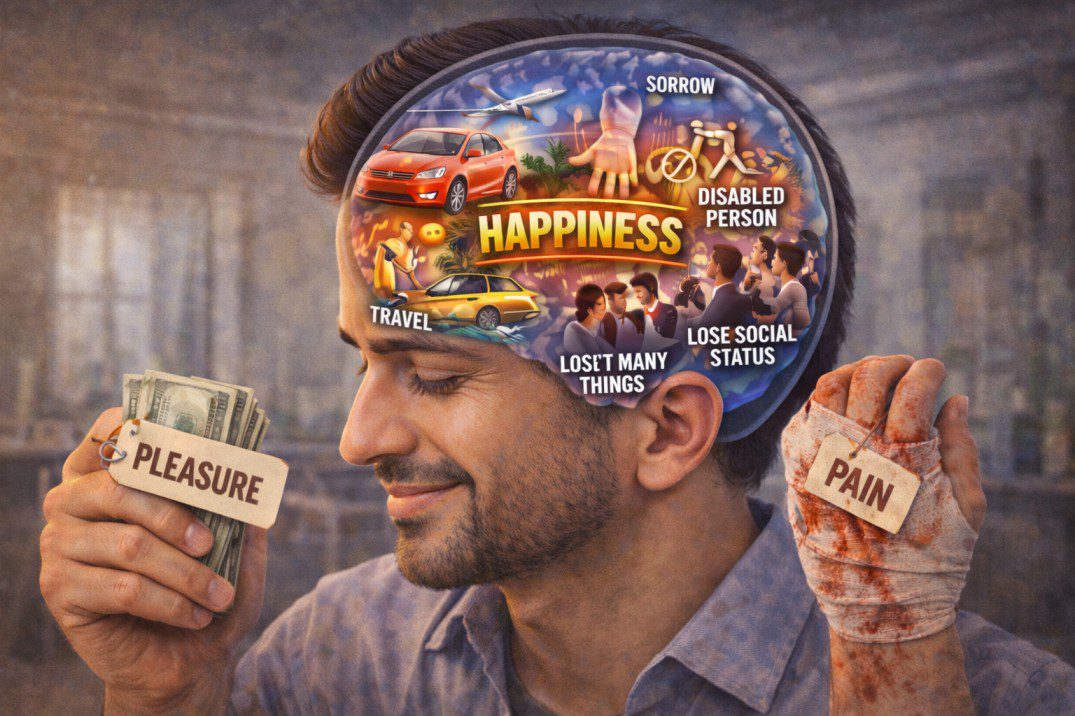
Human attraction toward money and wealth is another survival-driven animation. The brain associates resources with:
- Physical comfort
- Social stability
- Increased mating and reproductive opportunities
- Enhanced survival and genetic continuity
Thus, the desire for money, power, or knowledge is rooted in biological fitness, not free choice.
7. Plants and Natural Programming
Plants produce food through photosynthesis, a chemically programmed process converting sunlight into energy. No intention, no planning—just natural law in action.
8. Living vs Non-Living: A Human Label
What we call “living” and “non-living” are distinctions made by one chemical system (humans) about other chemical systems(water bodies, soil, animal, air, stone, etc.). Water moves due to heat energy; humans move due to biochemical energy from food.
The difference lies in type of movement, not in the existence of movement itself.
9. Is Anything Truly Alive or Dead?
Human bodies take food, produce sperm and eggs encoded with genetic instructions, assemble new bodies, and eventually decompose which is another state of this body. The same molecules return to soil, air, and water.
Forms change. Processes continue.
From this perspective, “alive” and “dead” are temporary descriptions of ongoing transformations.
10. Is There Anything Good or Bad?
There is no inherent good or bad; everything is simply a result of chemical composition. Everything happens on its own due to the chemical makeup of a given formation—whether human, animal, ocean, or pond.
If a person does something, it depends entirely on their neurological and bodily functions, as well as the experiences they have had so far: the food they consumed, the books they read, the people they interacted with, the relationships they formed, and even the weather they were exposed to.
11. Where Is the “I”?
If an observer(another machine) from a distant galaxy measured Earth, it would detect only motion under forces: attraction, repulsion, chemical reactions, physical interactions. Wars, peace, love, hatred—everything appears as activity within matter- a chemical process.
So where is the “I”?
Can it be found in molecules? In neurons? In chemical reactions?
Yet, the sense of “I” feels undeniable.
What is its origin?
Is it real, or another construct arising from complex neural processes ?
That inquiry opens a deeper investigation.
Conclusion: An Ongoing Inquiry
Everything appears as a beautiful, self-running animation of nature. Forms arise, transform, and dissolve. The question of “I” remains—not answered here, but clearly revealed as something worth examining beyond surface assumptions.
That, however, is another story.
The Origin Of ‘I’.