
Introduction
Everyone has felt and continues to feel happiness and sorrow throughout life. Yet we live this duality unknowingly, without truly understanding what happiness and sorrow actually are. With careful observation, one can detect happiness or sorrow arising, but one cannot get rid of this duality — because, in reality, there may be no happiness or sorrow at all.
If something does not truly exist, then how can one get rid of it? Are happiness and sorrow merely illusions created by the brain? If they are illusions, how can one remove them? Let us explore this deeply.
Pain and Pleasure Are Real
Yes, of course, pain and pleasure exist.
- If you get a wound on your hand, you feel pain.
- If you have a headache, stomach ache, hunger, or someone beats you, you feel pain.
- These are real experiences.
Likewise, pleasure is also real.
- When you taste delicious food, you feel pleasure.
- When you dance, have sex, sleep well, take a shower, or feel relief after gut clearance, pleasure is experienced.
Pain and pleasure are real biological experiences.
Neuroscience confirms that pain and pleasure arise from sensory input and neurochemical activity in the nervous system, involving structures like the somatosensory cortex, dopamine pathways, and endogenous opioids. These are measurable and factual experiences.
Then What About Happiness and Sorrow?
Happiness = Extension of Pleasure in the Imagination of the Brain
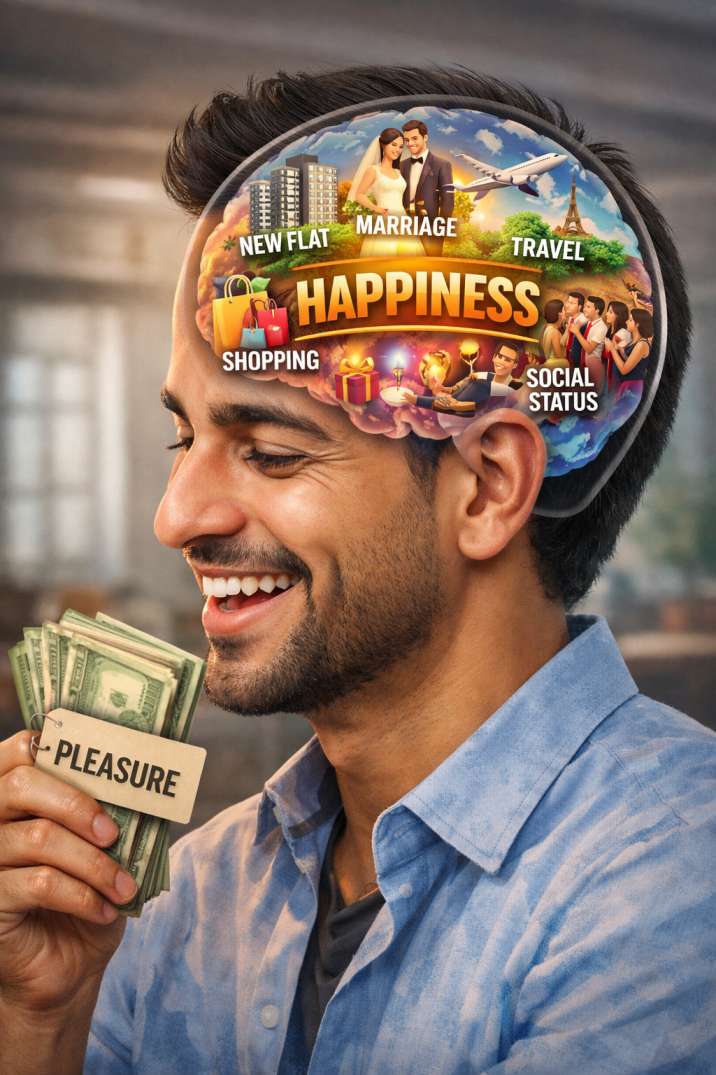
Happiness is the extension of pleasure into imagination.
Example: First Salary
Suppose you receive your first salary.
- Receiving money is a fact.
- The pleasant sensation you feel is real pleasure.
But where does happiness come from?
Happiness arises when the brain extends this pleasure into future imagination:
- Now you can earn regularly.
- Your survival capacity increases.
- You gain social acceptance.
- You may marry.
- You may have emotional and physical comfort.
- You can raise children and support a family.
All these imagined future possibilities create happiness. This imagination can be called positive desire (+ve desire).
But are these imaginations true?
No.
They are probabilities, not certainties.
The world is chaotic, uncertain, and constantly changing. Everything can change — and it does. Thus, happiness is simply the brain extending a present pleasure into imagined future security.
This extension of pleasure into imagination is called happiness.
A Slight Change in the Same Example
Now consider a small change.
- You get the same job, but only for one day.
- You will be paid after the work.
- It is 100% certain the job will end after one day.
- You cannot tell anyone about this job.
- You will not receive experience certificates or future benefits.
In this case:
- You will still feel pleasure after getting paid.
- But there will be no happiness, because the brain knows there is no future imagination to extend into.
However, if the brain creates negative future imagination:
- From tomorrow there will be no salary.
- You must struggle again.
- Survival feels uncertain.
Then sorrow arises.
Why Dating Feels Good but Relationships Create Happiness and Sorrow
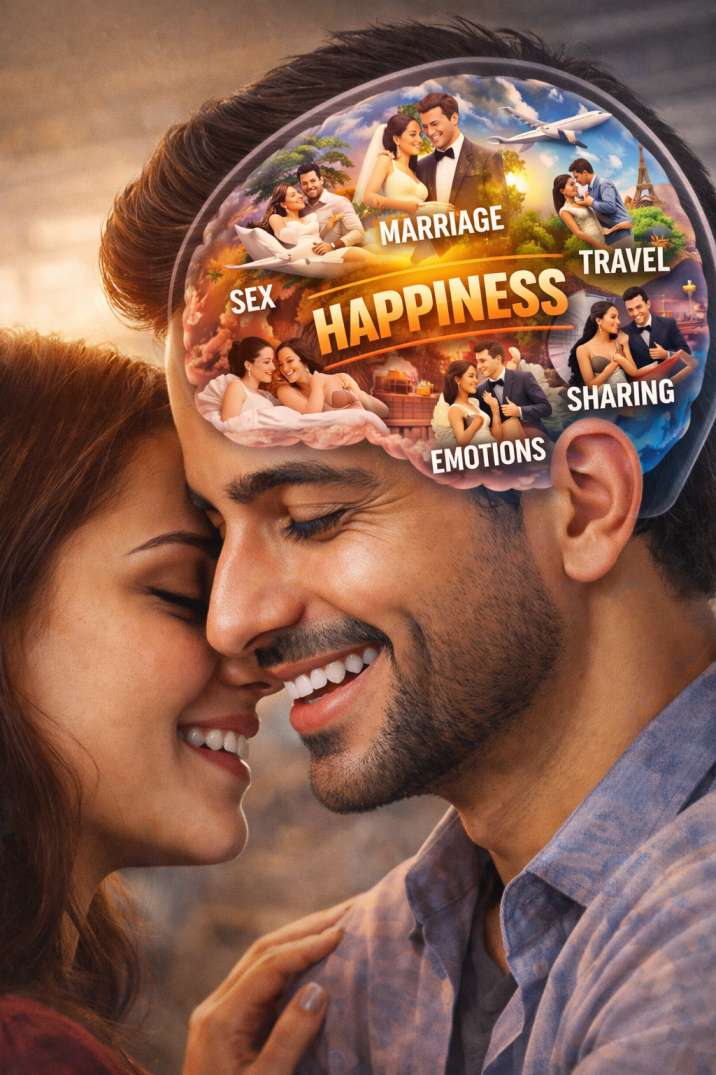
Suppose you are dating a girl. When you spend time with her, talk to her, or sit close to her, your body experiences pleasure. Hormones are released, emotional bonding occurs, and the nervous system feels good. This pleasure is real and happening in the present moment.
But happiness does not come from this pleasure alone. Happiness arises when the brain begins to imagine a future — staying together for life, marriage, sex, traveling together, sharing experiences, building memories, and creating a story around the relationship.
All of this exists only in imagination. It has probabilities, not certainty.
If these imagined futures appear positive, the mind feels happiness. If the imagined futures appear uncertain or threatening — separation, rejection, or loss — the mind feels sorrow.
So pleasure is real and immediate, but happiness and sorrow are psychological extensions of that pleasure or pain into imagined future or remembered past.
What Is Sorrow?
Sorrow = Extension of Pain in the Imagination of the Brain
Example: Not Getting a Job
- You are working hard.
- You are not getting a job.
This is a fact, not sorrow.
If one job does not happen, your body and brain will eventually find some other work for survival.
But sorrow arises when the brain imagines:
- Loss of preferred future.
- Reduced social validation.
- Reduced comfort.
- Threat to survival probability.
These imagined scenarios create sorrow.
Pain is real.
Sorrow is imagined.
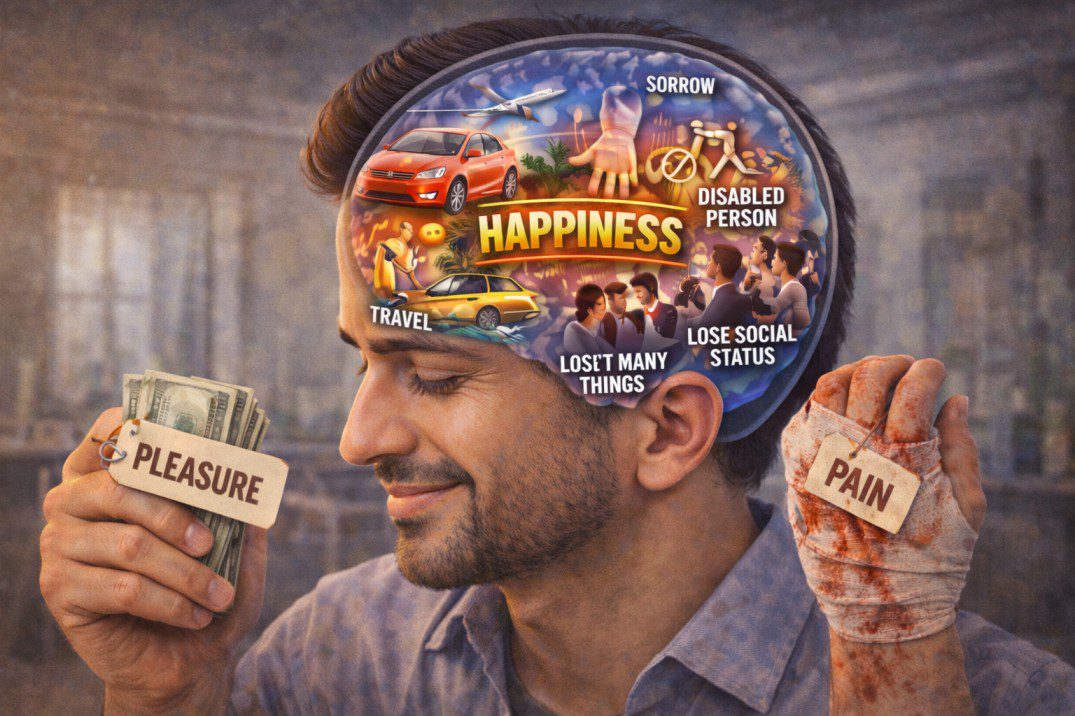
Another Example: Physical Injury
- You get a wound on your hand.
- You feel pain — it is real.
- You take medicine — pain reduces.
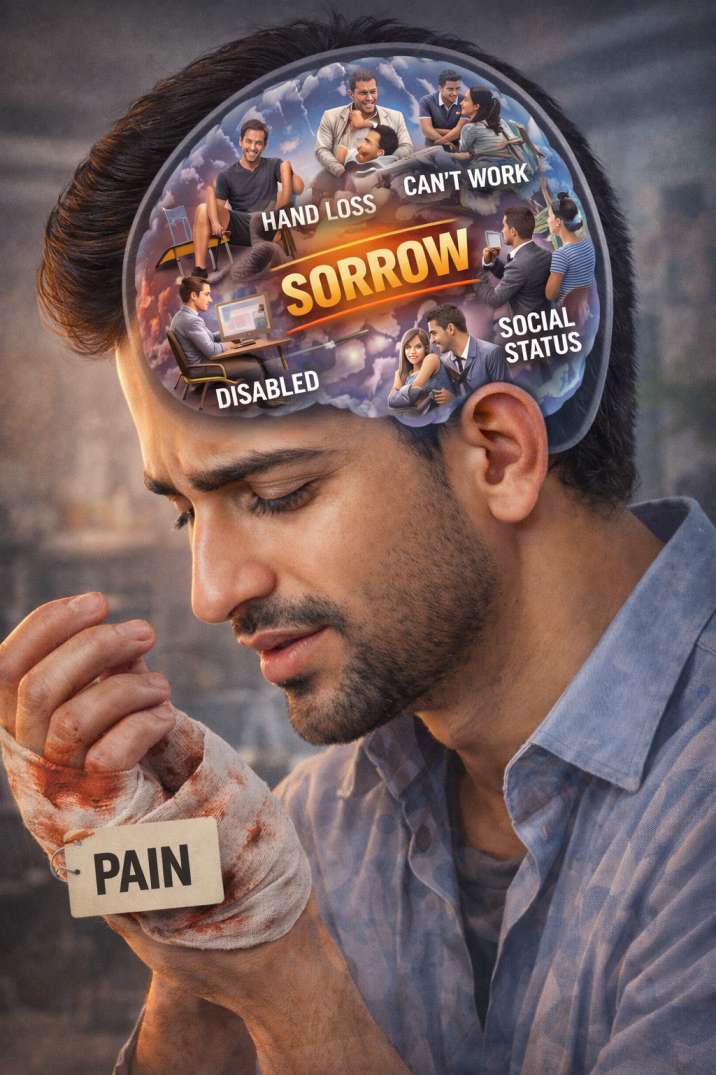
There is no sorrow here.
But if the brain imagines:
- The hand may be amputated.
- Society will label you as disabled.
- Job opportunities will reduce.
- Social and sexual validation will decrease.
Then sorrow and depression arise.
But the reality is simple:
- The hand is gone (if it happens).
- Certain activities may not be possible.
- Society may react in specific ways.
Still, the body and brain will adapt and find new ways to survive and express potential.
Stephen Hawking Example
Stephen Hawking initially became depressed due to his disease. The depression existed in the brain’s imagination. Once that imagination dissolved, his body and brain found alternative ways to function, communicate, and contribute profoundly to humanity.
Work Without Psychological Burden
This does not mean:
- You should stop planning.
- You should stop worrying/enjoying, it is automatic process.
- Worry is a biological defense mechanism.
- It helps solve immediate problems faster.
Rather:
- Work hard.
- Improve yourself.
- Plan intelligently.
When you work without unnecessary ideas of happiness or sorrow—without the desire for future happiness or the fear of failure—your work becomes more focused and proficient. In such a state, satisfaction arises during the very act of working itself, not from waiting for the result.
The body and brain are survival-oriented systems. They naturally and automatically find ways to adapt to situations. So why suffer emotionally in advance? Worry and anxiety are defense mechanisms of the brain—default functions meant to anticipate danger and take precautions. You cannot completely stop them, but by understanding their nature, you can remain equanimous in all situations. With this equanimity, excellence in any field becomes possible.
But happiness and sorrow are fleeting mental states.
What causes sorrow today may become happiness tomorrow. So just ignore them or treat them with equanimity. Sorrow and happiness both are brain’s imagination which is impermanent.
Desire, Attachment, and Detachment
From pain and pleasure, the brain creates imagination — which becomes happiness and sorrow.
This imagination is called desire.
There are two types of desire:
- Positive desire (+ve desire) – wanting, attachment
- Negative desire (−ve desire) – aversion, detachment
Attachment and detachment are essentially the same.
- Attachment to name, fame, money, power, and knowledge creates happiness and sorrow.
- Detachment from the same things also creates pride and sorrow.
Even renunciation can become a source of ego and emotional fluctuation.
True clarity comes from simply observing reality as it is, without attachment or detachment.
Happiness and Sorrow Are Like a Mirage
Happiness and sorrow are like a mirage.
- The mirage does not exist.
- Yet it appears real.
Once you know a mirage is an illusion:
- You still see it.
- But you no longer chase it.
Similarly, by observing happiness and sorrow deeply, one understands their imagined impermanence nature. They may arise, but they can be ignored.
The Final Question: Who Is “I”?
Now another question arises:
- Who feels happiness and sorrow?
- Who observes and ignores them?
The answer seems to be the same — “I”.
But who is this “I”?
- Does this “I” truly exist?
- Or is it also another illusion created by the brain?
Well…
That is another story.
Who am I? https://mindalysis.com/im-the-ghost/